The way contemporary design relates to time reveals far more than a stylistic preference. It reveals a value system. And that system is under pressure: the product life cycle — from production to disposal — has become a variable that can no longer be ignored, neither on environmental grounds nor on cultural ones. The answer cannot be purely technical. It has to be aesthetic.
For decades, we have built a visual language founded on newness: perfect objects, intact surfaces, catalogs in which every product appears as though it has just left the factory. A powerful, coherent language — and a deeply misleading one. It has taught us to read wear as deterioration, the marks of time as a loss of value, and replacement as a natural, almost hygienic gesture.
The result is a cultural short-circuit before an environmental one: we discard what still works because it no longer looks new. And yet there are other ways of seeing things. Ways in which the patina of time is beauty, not flaw. In which a lived-in object tells something a new one never could. In which lasting is not a limitation of design, but its highest proof.
This article is an invitation to step back from the cult of the new — in the name of a more mature and more honest aesthetic. Because durability, wear and giving objects a second life are not a compromise. They are a cultural and aesthetic value in themselves. And recognising that is urgent: environmentally, yes — but above all, in the language through which design tells its story.
Time in architecture and design
In architecture, coexisting with time has never been experienced as a problem. It is embedded in the very logic of building: structures move through eras, change function, are modified, extended, layered. Accretions — the additions made to an original structure across different periods, often inconsistent in style or material — are a normal condition of the built heritage, not a defect to be corrected.
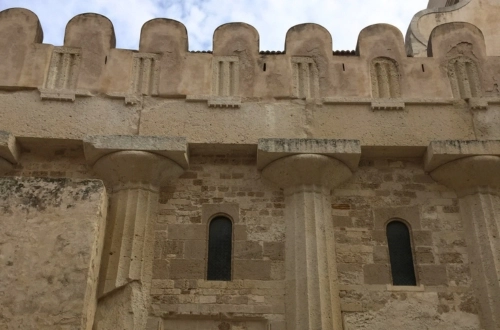
Think of how many examples we have of architecture that has not fought the passage of time but welcomed it: medieval churches built on Roman foundations, Renaissance palaces whose courtyards changed purpose across the centuries, entire historic centres where each era has left a legible mark without erasing what came before. The richness of these places is made precisely of this layered complexity — not despite the changes, but because of them.
In product design, this awareness has been slower to arrive. For decades, design has treated perfection as a state to be reached and maintained. Surfaces immune to use, finishes that must not show wear, catalogs where every object is photographed pristine and untouched. This aesthetic carries a cost: it teaches us to perceive the ageing of objects as deterioration, the sign of time as a loss of value. The consumer, trained this way, comes to regard only the brand-new as truly desirable — and tends to replace what barely left its packaging, even when it works perfectly. It is a cultural misunderstanding that precedes, and fuels, the environmental one.
Try searching for images of furniture or product design that show real signs of use. Not broken objects — used ones. Functional, but lived-in. It is surprisingly difficult to find them. The relationship between wear and design in visual communication is almost always negative: wear as something to avoid, delay, conceal. As if showing an object’s history meant revealing its weaknesses.
On this subject, Mario Trimarchi — one of the most perceptive voices in Italian design — offered a remark that functions as a manifesto, in a conversation about his project for the copper-bodied Samotracia motorcycle with De Castelli. In a video interview he gave for my YouTube channel, one sentence stood out: “When you buy a vehicle it is perfect, so it can only get worse. If instead you design a motorcycle in copper, you enjoy the passage of time on it — and you give a design object the beauty and nobility of a house roof.”
A copper roof that oxidises, turns verdigris, acquires a chromatic quality impossible to replicate artificially: it is the most precise image of what we are talking about. Not an object that resists time, but one that lives through it — and its own function — in an entirely natural way.
A culture of time
The most articulate reference point for this sensibility is the Japanese philosophy of wabi-sabi, which has offered for centuries a profound aesthetic understanding of time. Wabi is the beauty of the essential, of what needs no ornament. Sabi is the quality of what bears the marks of time — not despite its imperfections, but through them.
Kintsugi is its best-known expression: ceramics repaired with gold or silver, where the fracture is not hidden but illuminated. The break becomes a chapter in the object’s life, not its ending. The beauty of imperfection is not an abstract category here — it is something you can see, concretely.
In everyday life, the examples are everywhere, once you learn to look. An old wooden floor that has absorbed decades of footsteps tells a story a new floor cannot — and has a quality no artificial finish can replicate. A moka pot used every morning for years makes better coffee than a new one: the internal patina is not residue, it is seasoning, a layer of polymerised oils that improves every extraction. The same applies to cast-iron cookware: the more you use it, the better it performs, the more precious it becomes. Time here is not an enemy of function — it is part of it.
Does everything need to be new?
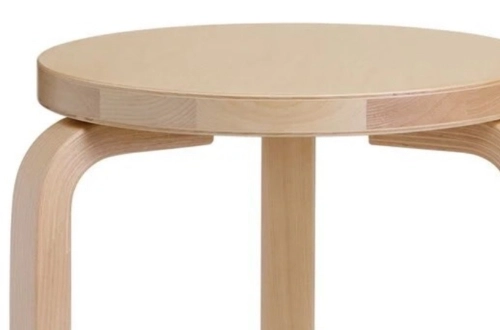
Some objects seem immune to time. Not because they withstood the trends, but because they were never made to follow them. Marcel Breuer’s S 64 for Thonet (1929), Eileen Gray’s E1027 table (1927), Alvar Aalto’s Stool 60 (1933), Wilhelm Wagenfeld’s WG 24 lamp (1924), Le Corbusier, Jeanneret and Perriand’s LC4 (1928): these are just a few examples of objects designed a century ago that still feel current today. What they share is not a style: it is an absolute coherence between what they are and what they do. Not classics by convention, but enduring by necessity.
In each of them, form and function coincide so completely that there is no room for the superfluous. The S 64 was born from the idea that a continuous steel tube could replace four legs: structure and form are the same thing. Eileen Gray’s E1027 — one of the most copied tables in the world — adjusts in height and angle because it was designed to accompany someone reading in bed: the function is so precise that the form could not be otherwise. Aalto’s Stool 60 has three legs in heat-bent birch, stacks, works anywhere, and asks nothing.
These are objects whose product lifespan is, in practice, indefinite — not because they are indestructible, but because they never become irrelevant.
Iconic objects that evolve without losing their identity
There is a different but equally significant category: objects that change over time — acquiring new functions, updating their components — without losing their formal identity. Two Italian examples illustrate this clearly.
Vico Magistretti’s Eclisse lamp (1965), awarded the Compasso d’Oro in 1967, works through a rotating inner shade that “eclipses” the light source, shifting between direct and diffused light. Over the years, Artemide improved its function — adding a disc so the shade can be moved without burning your fingers — and updated its finishes through PVD technology: physical vapour deposition, a vacuum-coating process that produces finishes in black, brass, copper or mirror with near-zero environmental impact, no acid emissions, and minimal waste. The form has not changed. The material has evolved, becoming more durable and more sustainable. Eclisse is part of the permanent collections of MoMA in New York and the Triennale Design Museum in Milan: a 1965 object that in 2026 feels more relevant than many products launched this season.
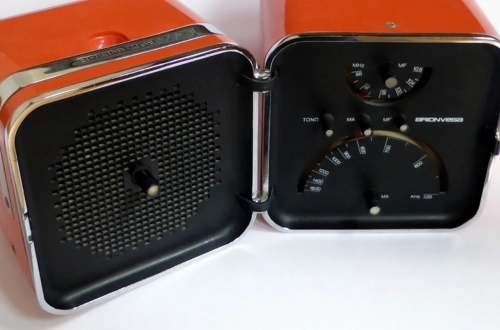
The Radio Cubo by Brionvega, designed by Marco Zanuso and Richard Sapper in 1964, was the first coloured radio, with a cubic form that separated speaker and electronics in a then entirely original gesture. Over time, the components were updated out of technical necessity: it now carries FM stereo, digital DAB, Bluetooth and a lithium battery. The casing has remained identical. The object’s recognisability is intact. What changed is only what needed to change.
Anonymous design and the Super Normal
Not every object that passes the test of time carries a signature. In 2006, Jasper Morrison and Naoto Fukasawa presented the exhibition Super Normal in Tokyo: a selection of objects — some celebrated, many anonymous — united by their capacity to perform their function so naturally as to become invisible in daily use.
The Bialetti moka pot. The paper clip. The Rex vegetable peeler. A well-proportioned mass-produced drinking glass. Objects we take so entirely for granted that we no longer see them — and yet whose absence would be a genuine loss. Morrison wrote that anonymous design often surpasses its authored equivalents “when it comes to long-term daily use”: not because it is more beautiful, but because it does not compete for the attention of whoever uses it. It steps aside, and does its job well.
Bruno Munari had the same intuition as early as 1972, with his provocative “Compassi d’Oro a Ignoti” published in Ottagono: an invented award to give recognition to well-designed, well-sold objects whose designer’s name nobody knows. The intelligence and spirit of the maestro are all in that gesture: the signature is not the value. The value is in the thing itself.
The product life cycle: the phase we overlook
The product life cycle is an established analytical tool in sustainable design. And yet the use phase — the longest, the one in which an object stops being perfect — remains the least considered at the design stage and the least addressed in communication.
An object made with high-impact materials can prove, over a thirty-year horizon, far more sustainable than a “lightweight” product replaced every three years. The relationship between durability and environmental impact is inverse — and ignoring it means working with an incomplete model. Designing for durability means anticipating time: thinking about wear, repairability, ease of maintenance.
A responsibility that does not end at the moment of delivery.
And when an object has truly exhausted its first life, the most interesting question is not how to dispose of it — but how to give it a second one. Here, design for disassembly becomes essential: designing objects from single-material components, assembled without glue or permanent bonding, that can be repaired or replaced selectively. An approach that extends product lifespan and simplifies end-of-life.
Giving objects a second life: the Dutch model and Milan’s prisons
The principle of giving objects a second life has found some concrete and surprising applications in recent years.
A particularly structured example comes from the Netherlands, where the government has made furniture reuse a concrete public policy measure: 70% of furniture in public procurement must be second-hand — not simply made from recycled materials, but recovered, refurbished and put back into circulation.
Within this framework, the Dutch Custodial Institutions Agency (FB DJI) introduced a nationwide system for refurbishing and redistributing used office furniture. The system is now managed by the Sustainable Inventory Bureau (DIB), which tracks the availability and condition of each piece: where reuse is possible, furniture is reconditioned and redelivered; otherwise, circular suppliers are involved. In 2024, 77% of replaced furniture was reused or refurbished, with a 60% reduction in material use.
In Milan, the Second Chance project — coordinated by the City Council with the Regusto platform — collected furniture and products donated by local companies and redistributed them across the prison facilities of San Vittore, Beccaria, Bollate and Opera. In its first phase: over 43 tonnes of goods diverted from disposal, €135,000 of recovered value, 25 tonnes of CO₂ avoided. Pre-loved furniture stops being waste and becomes a resource again.
Both models also carry a strong social dimension: the refurbishment work is carried out by inmates within the prisons themselves, combining environmental sustainability and professional reintegration in a single coherent practice.
A shift in what we call desirable
For design to genuinely respond to the cultural shift that the times require — and to help drive it — a change of paradigm in how we design and communicate is needed. Abandoning the cult of the new at all costs is not enough. We need to learn to communicate objects differently: to show the product life cycle in its entirety, not only at launch, but across the years.
To make repairability an aesthetic argument, not just a technical one. To build narratives that keep pace with time, as the best design objects do. The brands that manage this will have something rare: a story that never grows old. And in a market where sustainability has become a positioning requirement as well as an environmental imperative, that story carries real weight.
Wabi-sabi is not a trend. It is a shift in how we see.
Note
The themes explored in this article were at the centre of The beauty of time – aesthetic code of sustainability, an event I had the pleasure of hosting on 24 February 2026 at the Nardi Showroom in Milan, Via Pontaccio 19, organised in collaboration with FLA Eventi. A morning of dialogue with architects and design professionals, in which time, material and the product life cycle were given the space they deserve — outside the margins of a technical datasheet and inside a real conversation. My thanks to Nardi for hosting and sharing this reflection with the same care and consistency they bring to their products: a company that understands what it means to design for the long term.
Working on a communication project?